
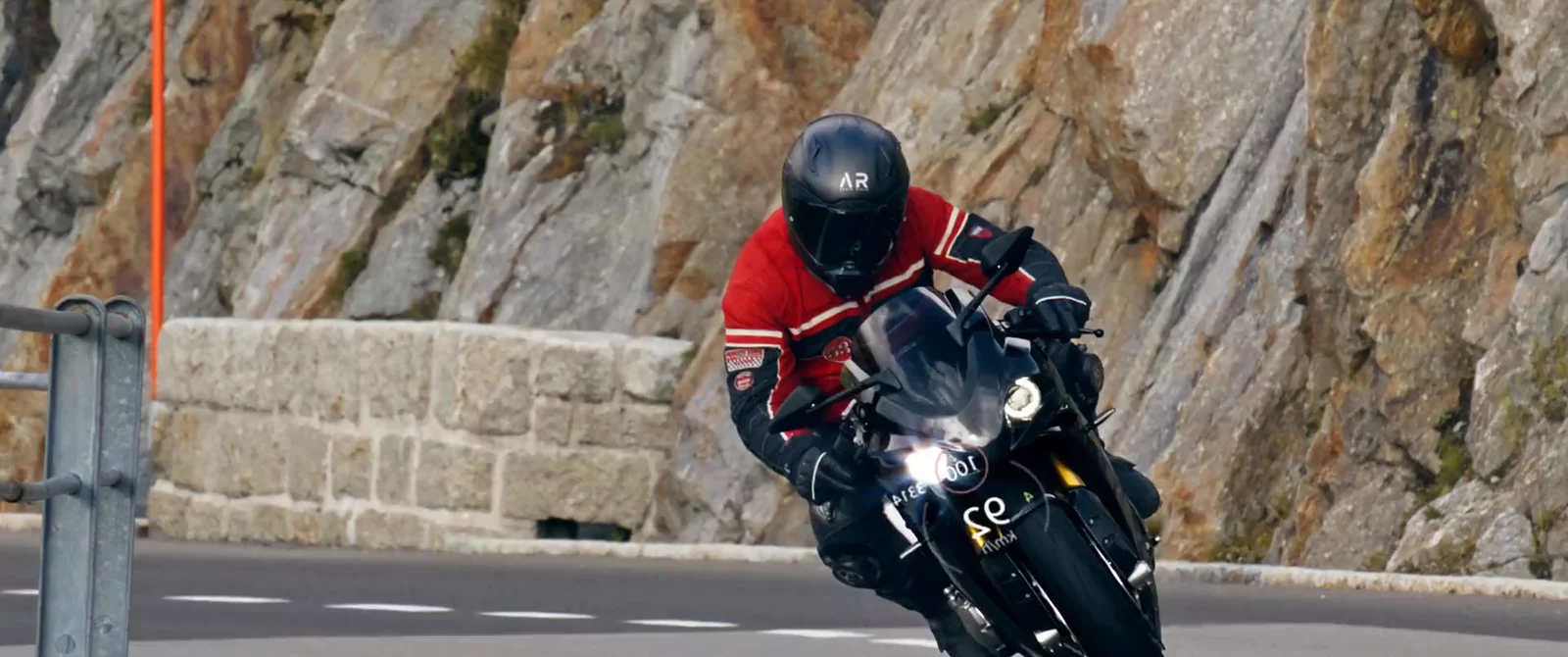
Our technology
Aegis Rider is the world's first motorcycle AR system with full spatial anchoring. Here's how we built it — and why it's harder than it looks.
The problem with today's HUD technology
How spatial anchoring works
-
Step 1
Track
A dedicated tracking camera built into the helmet captures your head's position and rotation in all six degrees of freedom — continuously, at high frequency, compensating for engine vibration, lean angles, and rapid head movements at speed.
-
Step 2
Anchor
The helmet's tracking data is fused with your smartphone on the handlebars into a single reference frame: your motorcycle. The system always knows where your head is relative to the bike — not just which direction you're looking, but exactly where you are in 3D space.
-
Step 3
Render
Content is placed in the real world, not on your visor. HUD elements sit in a fixed position ahead of the motorcycle. 3D navigation arrows appear at the actual junction. Turn your head to check a mirror, and the display leaves your view entirely.
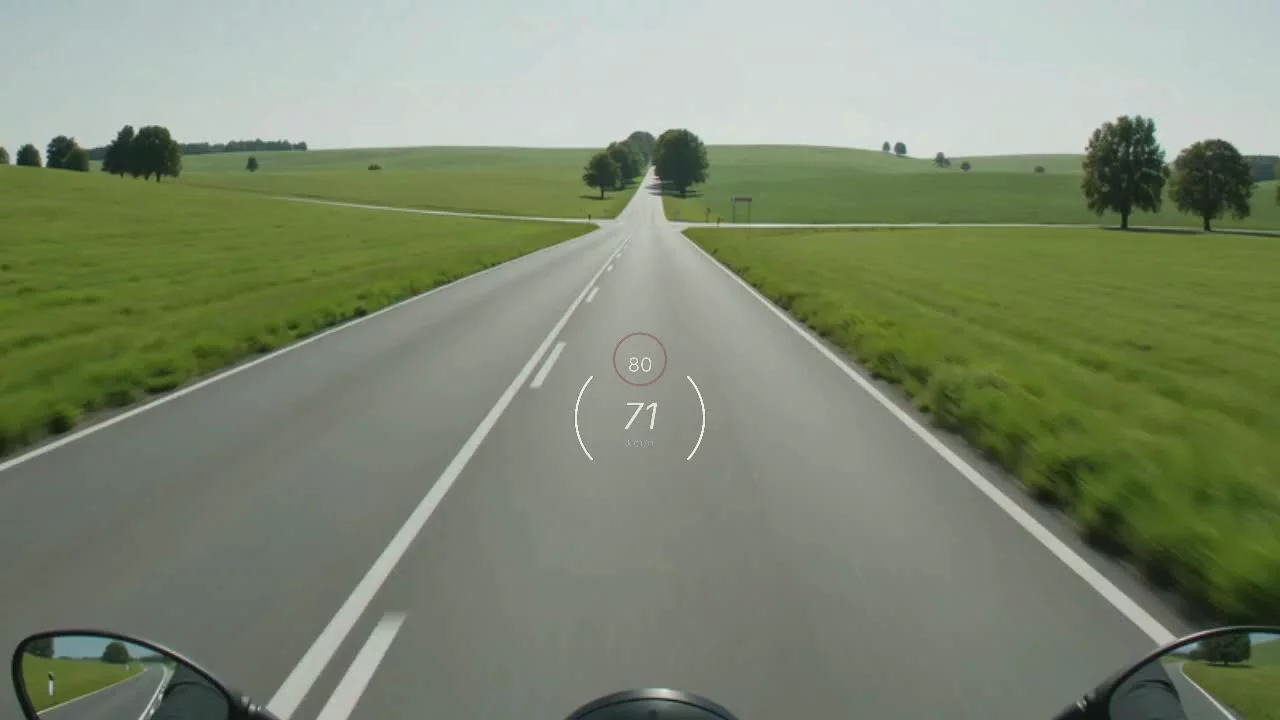
The display is fixed to your visor. It follows every head movement — checks, scans, glances. Simple, but it means the HUD is always in the way.
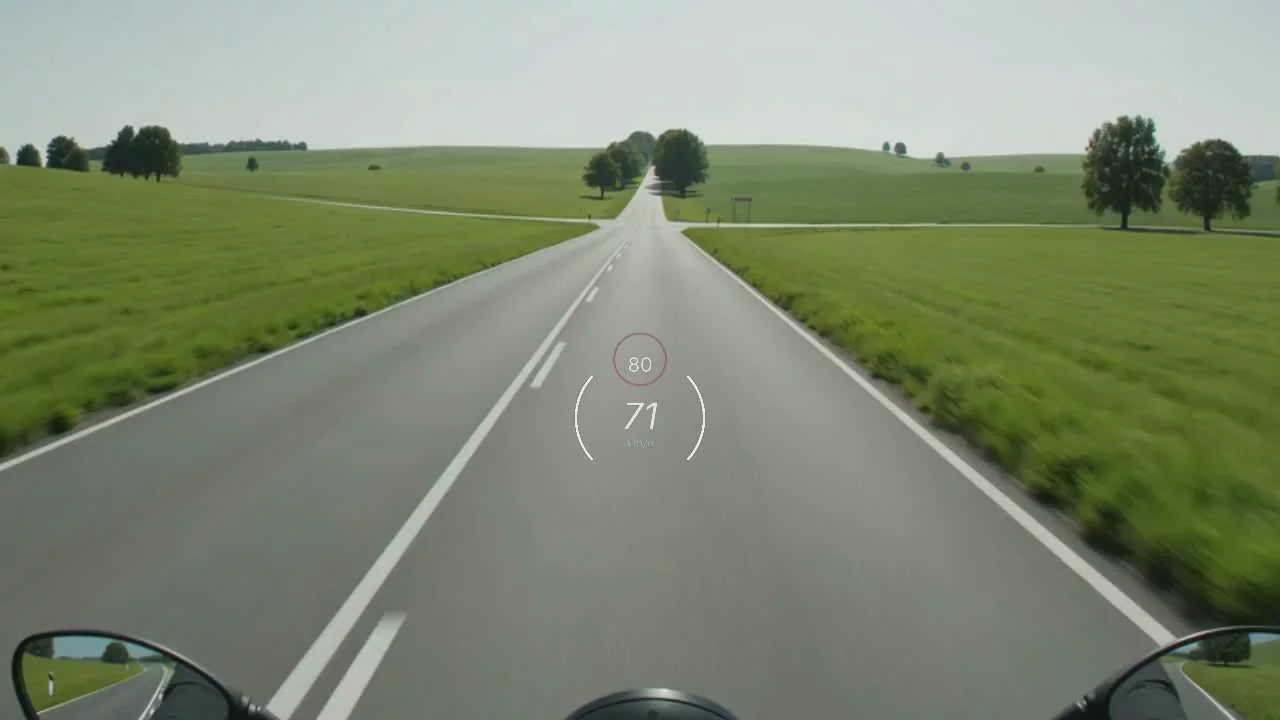
The HUD sits in a fixed position relative to your bike — typically a few metres ahead, configurable in the app. Turn your head to check a mirror and the HUD naturally leaves your view. Look forward again, it's right where you left it. Your speed, navigation, time, and calls live here.
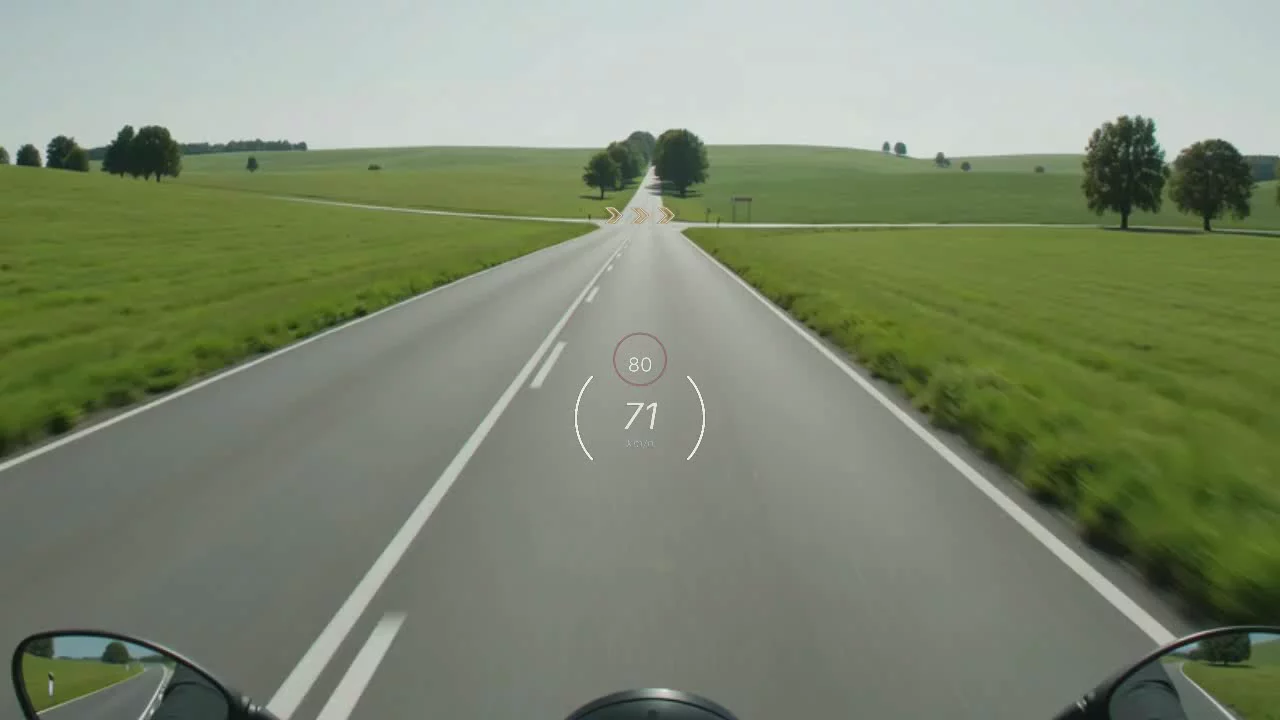
3D navigation arrows are placed at actual GPS coordinates. A right-turn arrow appears at the real intersection and grows as you approach. Ride past it, it stays behind you. This is AR navigation as it should work — the information is where the turn is.
The tech specs that matter
Everything a rider needs to know before ordering.
- Stereo optical combiner for showing content at various depths
- Resolution of 1080p per eye
- Content accurately anchored to vehicle and environment (sub-degree tracking accuracy)
- Very low motion-to-photon latency (<16ms)
- Embedded compute system running Android 13
- Real-time 6-DOF spatial tracking
- 128 GB internal storage (~100 GB for video)
- Built-in 7,000 mAh battery
- ~7 h usage with AR Optics
- USB-C charging, ~2 h for a full charge
- Front action camera: 1080p @ 30 fps, H.264/MP4, 135° FOV
- Rear action camera: hardware installed, activation via future update
- Tracking camera: dedicated to spatial anchoring, not user-accessible
- Bluetooth 5.2 for hands-free calls, music streaming and smartphone notifications
- WiFi 2.4 GHz for video transfer to smartphone and software updates
- Caller name and notification details on the HUD
- XS to 3XL (53–66 cm head circumference)
- Seven sizes for a precise, comfortable fit
- Based on the Nexx X.WST3 platform